Guestroom Sign Co · specification guide
Hotel Room Sign Requirements Explained: Tactile Characters, Braille, Height and Placement
Under the 2010 ADA Standards, signs naming permanent rooms, such as guest room numbers, need raised uppercase characters, Grade 2 braille and mounting 48 to 60 inches high beside the latch side of the door. Guestroom Sign Co does not make tactile or braille signs; we make decorative and visual hotel signs.
Reviewed 2026-09-05 · AI-assisted editorial review. General buying guidance; illustrative scenarios are not customer case studies. Images are AI-generated concepts.
This guide explains what those rules ask for in plain language, so you can confirm the details with your architect, accessibility consultant or local building official. It covers which hotel signs are tactile and which are visual only, what a tactile sign involves, where it goes on the wall, and how a decorative room plaque can sit beside the required sign.
Nothing here certifies a sign or a building. The authority that reviews your project decides what applies, and state or local codes can add to the federal standard. Use this page to ask better questions and to brief every supplier the same way.
Sources: U.S. Access Board: ADA Accessibility Standards (2010), sections 216 and 703
Which hotel signs need raised characters and braille?
Signs that name permanent rooms and spaces need tactile characters: guest room numbers, restroom signs, floor numbers, room names such as Ballroom, and exit doors to stairs. Directional and informational signs, like arrows to the pool or rules of conduct, need visual characters only. Some sign types are exempt entirely.
Section 216.2 of the 2010 ADA Standards covers designations, which its advisory describes as room and floor numbers, room names and restroom labels that are not likely to change. Section 216.3 sends directional and informational signs to the visual-character rules only. Section 216.4.1 requires tactile signs at exit stair and exit passage doors.
Section 216.1 lists exceptions, including building directories, menus, occupant names, building addresses, and company names and logos, plus temporary signs used for 7 days or less. That is why a hotel logo sign in the lobby is treated differently from the number on a guest room door.
Sources: U.S. Access Board: ADA Accessibility Standards (2010), sections 216 and 703
What does a tactile and braille room sign involve?
A tactile room sign has raised characters at least 1/32 inch high, in uppercase sans-serif letters between 5/8 inch and 2 inches tall, with contracted Grade 2 braille below the text. The surface must be non-glare, and characters must contrast with the background, either light on dark or dark on light.
These details make the sign a specialized product. Braille dots have set sizes and spacing, braille must sit at least 3/8 inch from the raised text and from borders or decoration, and the raised edges should not be sharp. Script fonts, italics and decorative letterforms are not allowed for the raised characters.
Because of those rules, a tactile sign is usually made by a supplier that produces raised characters and braille as its core work. Guestroom Sign Co's catalog does not include raised characters or braille, so we do not quote them.
Sources: U.S. Access Board: ADA Accessibility Standards (2010), sections 216 and 703
Where should a hotel room sign be mounted?
Mount the tactile sign beside the door on the latch side, with the baseline of the lowest raised character at least 48 inches above the floor and the highest at most 60 inches. An 18 by 18 inch clear floor space, centered on the characters, must sit outside the door's swing to 45 degrees open.
Double doors have their own rules. With one active leaf, the sign goes on the inactive leaf. With two active leaves, it goes to the right of the right-hand door. If there is no wall space on the latch side, it goes on the nearest adjacent wall.
Record the hardware side for every door in your schedule. Hotels often have mirrored room pairs, so the latch side flips from one door to the next down the corridor. Your installer needs that list, and so does anyone making a decorative plaque that has to fit around the tactile sign.
Sources: U.S. Access Board: ADA Accessibility Standards (2010), sections 216 and 703
Can a decorative room number plaque sit beside the required sign?
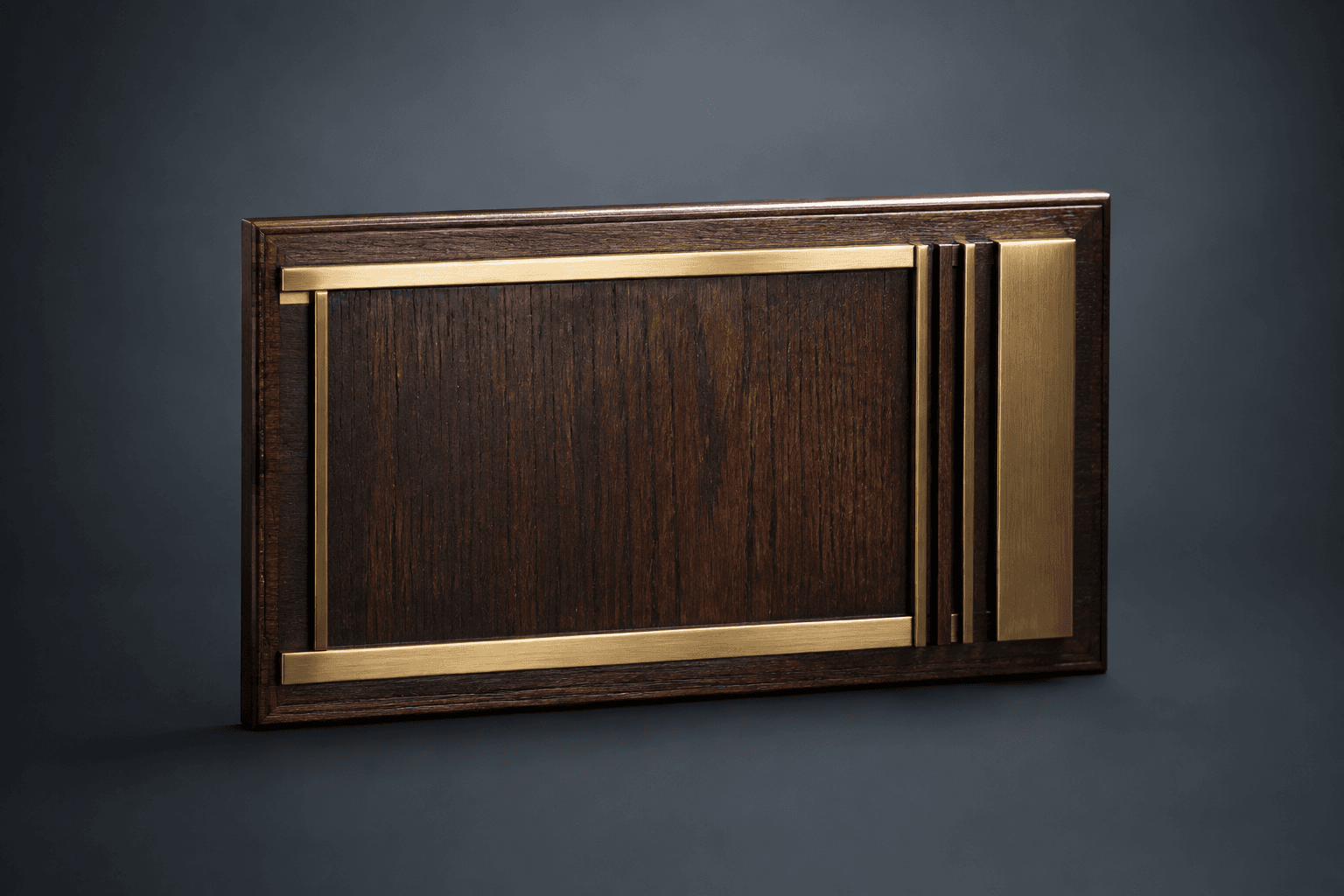
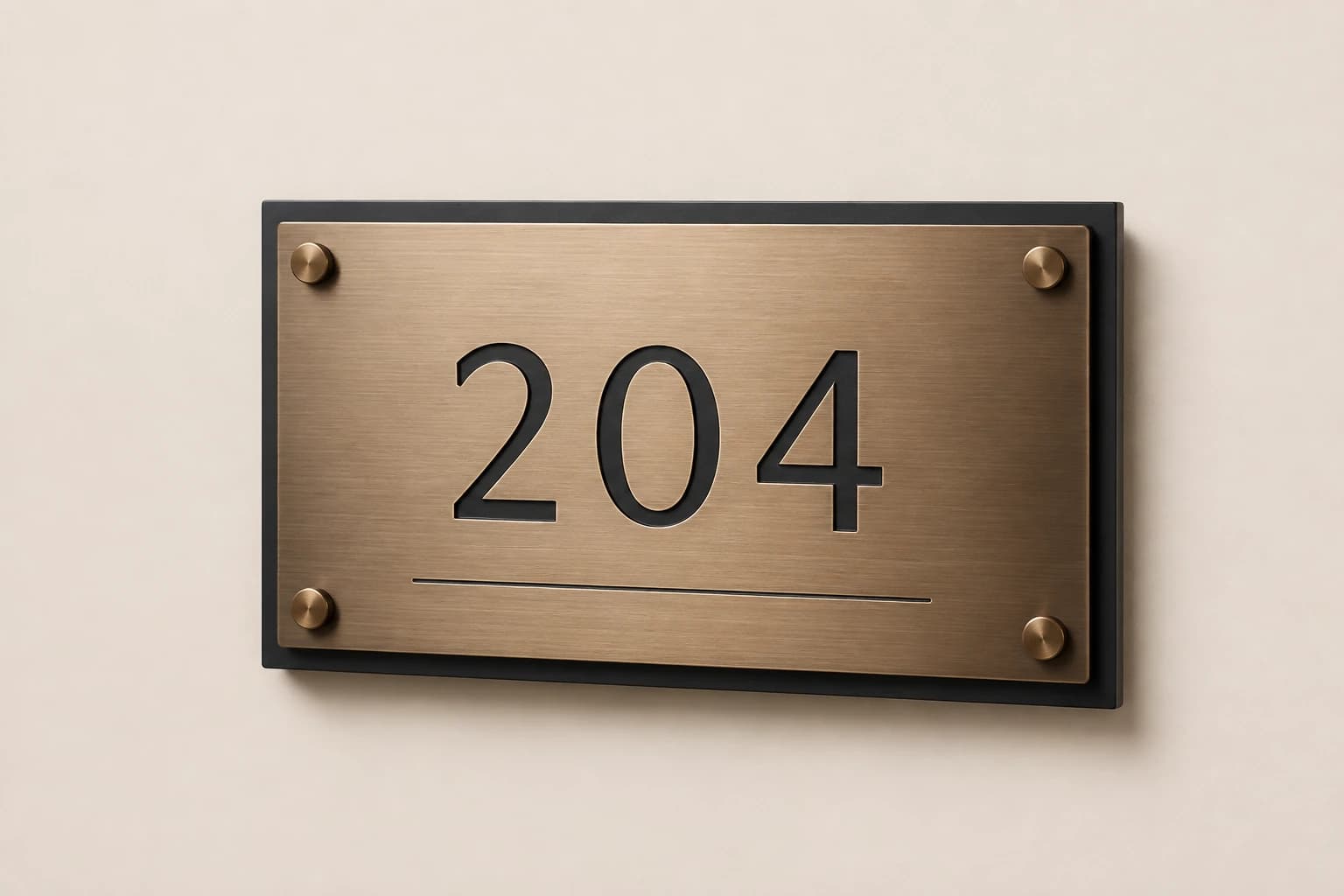
Yes, the standards allow the visual and tactile parts to be one sign or two separate signs. Many hotels pair a required tactile sign with a separate decorative number plaque on the door or wall. Your consultant should confirm which sign serves as the required visual sign and where each one goes.
If the decorative plaque is meant to be the required visual sign, its characters must meet the visual rules in section 703.5, including non-glare finish and contrast. If it is purely decorative, keep it from crowding the tactile sign's mounting zone or confusing which number belongs to which door.
That pairing is where Guestroom Sign Co fits. Our Hotel Room Number Signs, 6 by 6 inches per plaque, and Hotel Room Number Plaques, 4 by 3 to 6 by 4 inches, are decorative and visual pieces. Send your consultant's placement plan and we will design around it.
Sources: U.S. Access Board: ADA Accessibility Standards (2010), sections 216 and 703
Count the decorative and visual signs you will order
The example uses the illustrative 40-room hotel: 40 rooms with one decorative plaque each and 8 visual wayfinding signs, with no spares, for 48 pieces from us. Count tactile signs separately for your tactile supplier.
Method: Multiply rooms by decorative signs per room, then add separately entered shared-space and wayfinding signs and any spares. Counts do not establish compliance; tactile signs are not included.
Build your plan
Inventory is separate from design compliance. Supply the sign schedule, mounting locations and applicable requirements for review.
Who decides whether a hotel's signs comply?
Your architect, accessibility consultant and the local building official decide how the ADA Standards and any state or local code apply to your property. A sign maker cannot certify compliance by itself. Ask the responsible reviewer for the sign schedule, mounting heights and any local additions before ordering from anyone.
Some states adopt their own accessibility codes that go further than the federal standard, and renovation projects can trigger different review than new construction. Those decisions sit with your design team and the authority having jurisdiction, not with a product listing that uses the word compliant.
A good rule for any supplier, including us: ask for the specification they are building to and who approved it. If a seller promises compliance without seeing your door schedule, treat that as a warning sign.
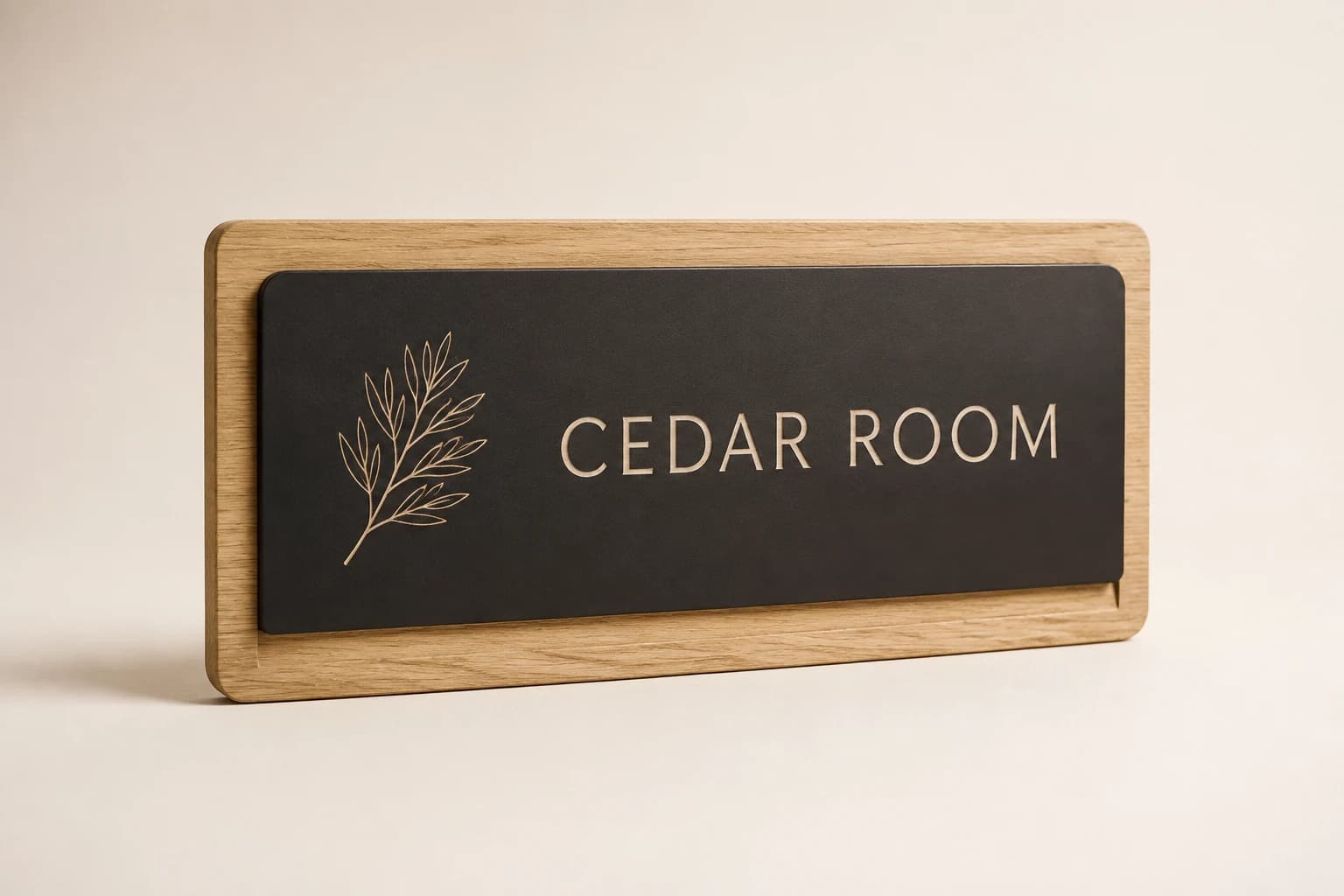
Which hotel signs are tactile, and what can Guestroom Sign Co quote?
This table sorts common hotel signs by the ADA category described above. Confirm each line with your reviewer. The last column shows only what our catalog makes.
| Option | ADA category | Raised characters and braille? | What we can quote |
|---|---|---|---|
| Guest room numbers | Designation of a permanent room (216.2) | Yes, on the required sign | A decorative visual plaque beside the tactile sign |
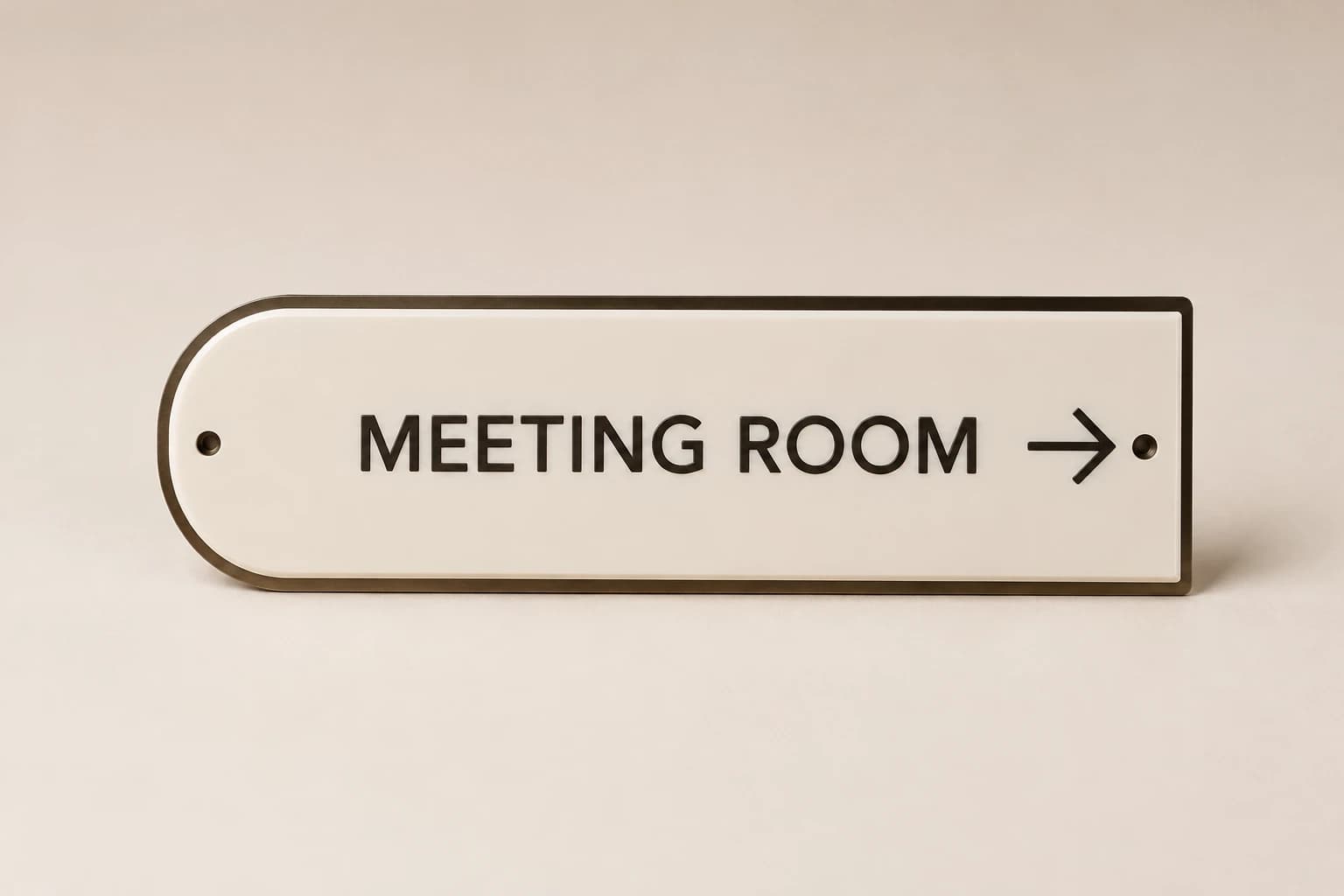
| Meeting room names | Designation of a permanent room (216.2) | Yes, on the required sign | A decorative Meeting Room Name Plaque beside it |
| Exit stair doors | Means of egress (216.4.1) | Yes | Nothing; source from a tactile sign supplier |
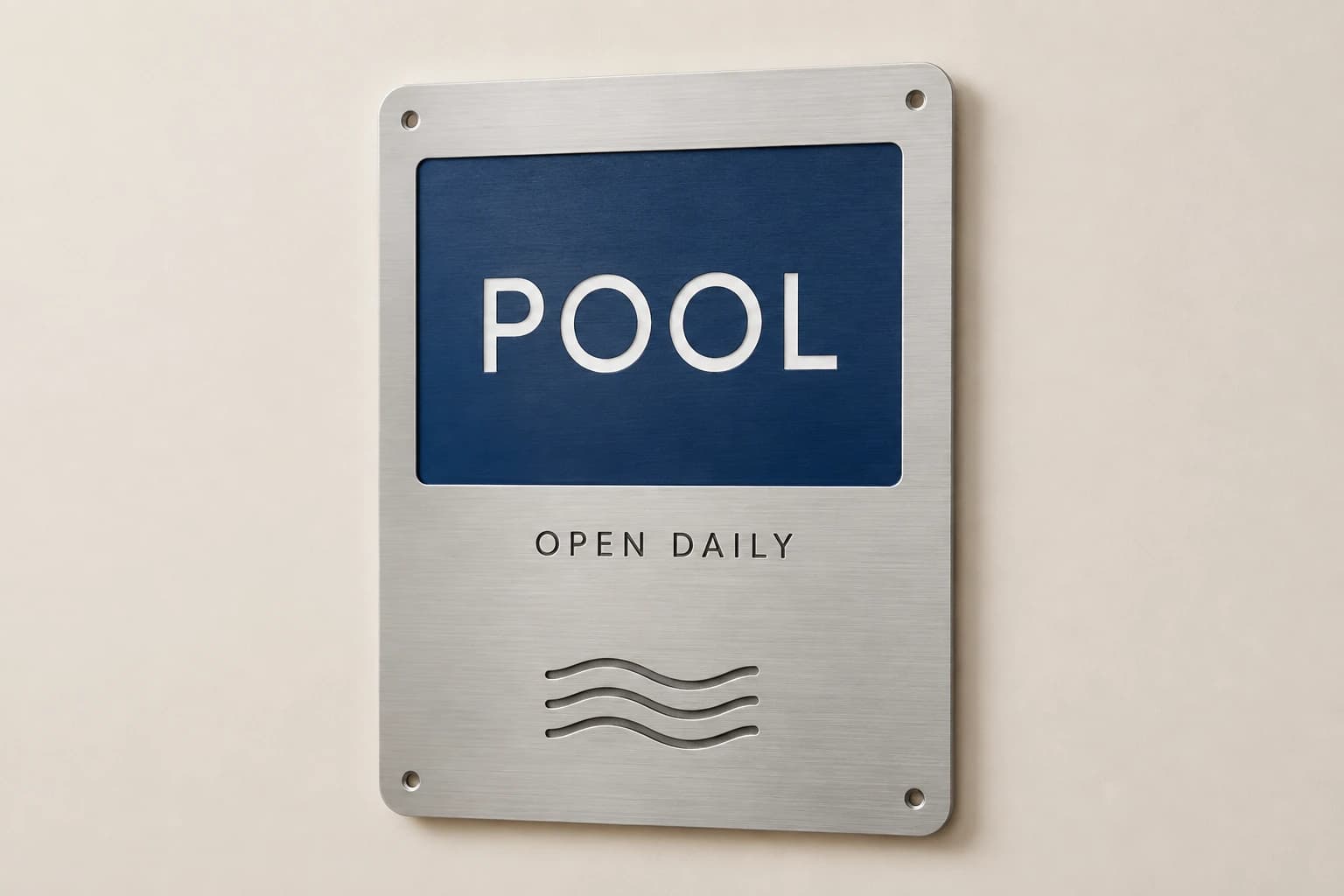
| Pool, gym and corridor arrows | Directional or informational (216.3) | No, visual characters only | Custom Door & Wayfinding Sign or Amenity & Facility Sign, to the visual spec you supply |
| Lobby logo and hotel name | Exception in 216.1 | No | Welcome Desk & Lobby Sign |
| Event and daily notices | Temporary, 7 days or less (216.1) | No | Changeable formats; ask for options |
What should you send when you request hotel signs?
Send a sign schedule listing every door and sign location, the door hardware side, wall material, your consultant's mounting plan and the name of your tactile sign supplier. Guestroom Sign Co will quote the decorative and visual signs our catalog makes, and production takes no more than 7 days plus shipping.
Keep room numbers as text in the schedule so leading zeros survive, such as room 021. Note mirrored room pairs, double doors and any door with no latch-side wall. Our guide to a hotel sign schedule by floor and location shows a layout that works for several suppliers at once.
If your visual signs must meet section 703.5, include those requirements in writing. We will tell you whether a catalog product can be made to them, and your reviewer makes the final call.
Illustrative example: a 40-room hotel with paired signs
In this illustrative example, a fictional 40-room boutique hotel wants walnut-style room plaques. Its accessibility consultant specifies a separate tactile sign at every guest room door, made by a tactile sign supplier, and a decorative number plaque centered on each door above the peephole.
The hotel orders 40 tactile signs from the tactile supplier and 40 decorative plaques from Guestroom Sign Co. It also orders 8 visual-only signs from us: pool, gym, ice machine and five corridor arrows, built to the visual-character spec the consultant provides. That is 48 pieces from us, at $69 to $159 for each room plaque and $49 to $149 for each wayfinding sign, before shipping.
The schedule lists 22 rooms with a left-hand latch and 18 with a right-hand latch, so the installer places each tactile sign correctly. The room count, layout and supplier split are invented to show how the two orders fit together.
Hotel room sign requirement questions
How much do hotel room number signs cost?
Guestroom Sign Co planning ranges are $59 to $129 per Hotel Room Number Sign and $69 to $159 per Hotel Room Number Plaque, with wayfinding signs at $49 to $149. These are decorative and visual signs; we do not make tactile or braille signs, so budget for those separately with a tactile sign supplier. Shipping is extra.
Do hotel room numbers need braille?
Under the 2010 ADA Standards, signs that designate permanent rooms, including guest room numbers, need raised characters and Grade 2 braille. Your architect, accessibility consultant or building official confirms how this applies to your property. Guestroom Sign Co does not make braille signs, so pair our decorative plaques with a tactile supplier.
How high should a hotel room sign be mounted?
For tactile signs, the 2010 ADA Standards place the baseline of the lowest raised character at least 48 inches above the floor and the highest at most 60 inches, beside the latch side of the door. Decorative plaques can go elsewhere, such as on the door, if your reviewer agrees.
Do you make ADA compliant room signs?
No. Guestroom Sign Co does not make raised-character or braille signs and does not claim compliance for any sign. We make decorative room plaques and visual signs. If you send visual-character requirements, we will say whether a catalog product can be made to them, and your reviewer decides compliance.
Do directional and amenity signs need braille?
Under section 216.3, directional and informational signs need visual characters that meet section 703.5, not raised characters or braille. Exit stair doors are different and need tactile signs. Confirm the list with your reviewer, then we can quote wayfinding and amenity signs made to the visual spec you supply.
Can a decorative plaque replace the required tactile sign?
Not if it lacks raised characters and braille. The standards allow the visual and tactile parts to be one sign or two separate signs, so a decorative plaque can be the second sign beside a tactile one. Your consultant decides which sign serves which purpose and where each is mounted.
Sources and scope
The sources below support the cited technical details. The ordering workflows are editorial recommendations. Your project specification, price and schedule are established in the written quote and approved proof.
- U.S. Access Board: ADA Accessibility Standards (2010), sections 216 and 703 · checked 2026-10-03
Which buying guide should you read next?
All buying guidesA useful sign schedule connects every physical sign to a floor, location, message and artwork revision. Count room plaques and shared wayfinding separately.
One double-sided sign can have two information faces while remaining one complete object. Count assemblies, inserts and artwork versions separately before comparing quotes.
Use one location schedule per property, with exact room identifiers, sign functions and face directions. Keep permanent room plaques separate from directional and changeable information. A common visual identity does not mean every corridor or mounting surface needs the same sign.
Keep the room’s stable identity recognizable while giving event names and times a clear place to change. Specify the display and its update process together.